Toyger
玩具虎猫 · Shorthair · striped tabby breed (United States) · United States (California)
The Toyger began in the 1980s in California, when Judy Sugden — daughter of Jean Mill, who founded the Bengal — noticed a scatter of tiny spots on the temples of one of her mackerel tabbies, an area that normally carries no pattern.
Quick facts
- Weight
- 7–15 lb (3.2–6.8 kg)
- Length
- body 17–20 in (43–51 cm), tail 12–14 in
- Lifespan
- 12–16 years
- Typical price
- $1,500–$4,000 in the US; in China ¥15,000–40,000
Temperament & lifestyle
About the breed
The Toyger began in the 1980s in California, when Judy Sugden — daughter of Jean Mill, who founded the Bengal — noticed a scatter of tiny spots on the temples of one of her mackerel tabbies, an area that normally carries no pattern. If a broken stripe could appear there, she reasoned, a circular tiger-face pattern was possible on a domestic cat, and a breed could be built around vertical, braided stripes rather than the usual mackerel bars.
About forty foundation cats went into the programme over the following years: Bengals, unpedigreed striped domestic shorthairs from several countries, and at least one import. TICA accepted the Toyger for registration in 1993 and granted full championship status in 2007. The stated aim was conservation as much as cats — Sugden wanted a house cat that would make people care about wild tigers.
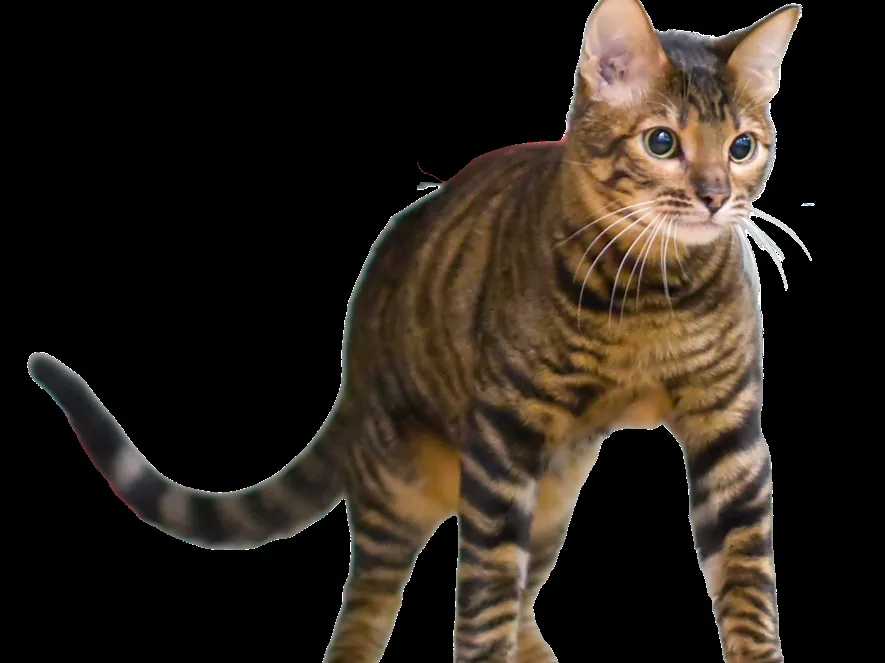
The result is a medium, muscular cat with a long low-slung body, small round ears set wide, and bold black stripes on a bright orange ground, often with a glittered, mica-like sheen. There is no tiger, leopard or any other wild cat DNA in it. Eight to fifteen pounds, and a tail usually carried low.
Care essentials
- Grooming
- Brush once a week with a rubber curry; the short pelt is dense but does not mat. The glitter coat looks after itself, so grooming is mostly about spreading oils and catching loose hair before it lands on the sofa.
- Exercise & play
- Needs daily structured play and something to climb, but is less frantic than a Bengal. Twenty minutes of wand work plus a puzzle feeder usually satisfies it; a catio is a bonus rather than a necessity.
- Feeding
- Muscular and moderately active; measured meals of high-protein food, two a day for adults. Keep it lean — the breed's long body shows extra weight quickly and loads the joints.
- Home setup
- Adapts well to flats and to families. It wants a tall scratching post, a sunny perch and human company in the evening; it is sociable enough that a second cat or a cat-friendly dog works well.
Health
- Heart murmurs and hypertrophic cardiomyopathy (HCM) — reported in the breed, though numbers are small; echo-screen parents
- Cow hocks — hind legs turning inward at the hock; breeders are asked to select against it, and it can affect gait
- Dental disease, the common feline problem, especially in cats fed soft food only
- Obesity in indoor adults, which stresses a long-backed frame
The Toyger is generally described as a healthy breed with no disease specific to it, but the caveat is population size: with roughly thirty active breeders worldwide, health data is thin and a single carrier can spread widely. Ask for HCM echoes on both parents and look at the hind legs while the kitten walks, since cow hocks are the one fault breeders actively select against. Everything else is standard cat care — teeth, weight, annual bloodwork after eight.
Health information here is general and not a substitute for veterinary advice. If your cat shows symptoms, contact a vet.
Frequently asked
Does a Toyger have tiger DNA?
No. It is a domestic cat built from striped tabbies and Bengals, and the Bengal's wild contribution comes from the Asian leopard cat many generations back. Any tiger resemblance is coat pattern and body proportion selected by breeders, nothing genetic from a tiger.
Is a Toyger as demanding as a Bengal?
Less so. Breeders and owners describe them as noticeably easier — they play in bursts rather than climbing the curtains all day, and they are less vocal. They still need daily interactive play and vertical space, but they settle into family life more readily.
How much does a Toyger kitten cost?
In the United States, roughly $1,500 to $4,000, with show-quality kittens at the top of that range; in China, ¥15,000 to ¥40,000. The breed is scarce — around thirty active breeders worldwide — so waiting lists and deposits are standard, and cheap offers usually mean no pedigree.
Care and health guides
Similar breeds
All breeds →