Scottish Fold
苏格兰折耳猫 · Medium shorthair · United Kingdom (Scotland)
The breed began with one cat.
Quick facts
- Weight
- 3-6 kg
- Length
- up to 65 cm including tail
- Lifespan
- 11-14 years
- Typical price
- $1,000-$3,000 (US, responsible breeder)
Temperament & lifestyle
About the breed
The breed began with one cat. In 1961 a white barn cat named Susie was found on a farm near Coupar Angus in Perthshire, Scotland, with her ears folded flat against her head. A local shepherd, William Ross, took a kitten from her and, with the geneticist Pat Turner, started a breeding programme that used British Shorthairs and later American Shorthairs to widen the gene pool. The folded ear turned out to come from a variant in the TRPV4 gene, which affects cartilage throughout the body rather than only the ear.
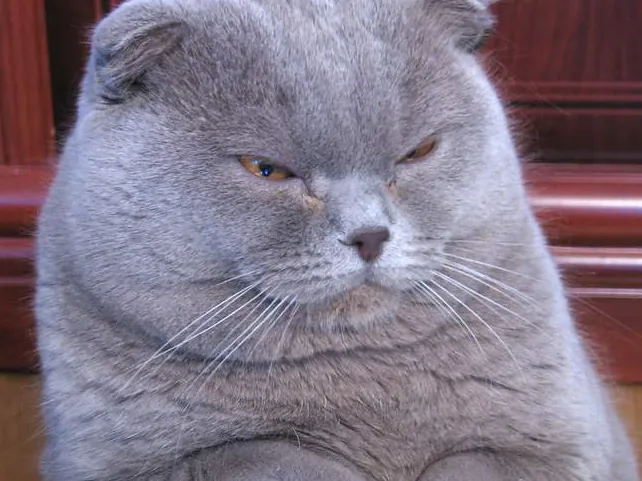
A Scottish Fold has a round head, large round eyes and ears that fold forward and down, which gives the face its owl-like look. The body is medium-sized and rounded, the coat short and dense, and every colour is accepted. Straight-eared kittens appear in every litter; they are registered as Scottish Straights and cannot be shown as Folds. The fold itself varies from a tight double fold to a loose single fold, and some cats' ears straighten as they mature.
The breed's popularity comes from that face, and so does its controversy. Because the same cartilage variant that folds the ears can cause osteochondrodysplasia, a painful joint disease, several countries have restricted or banned Fold breeding and every responsible registry forbids mating two folded cats. Anyone buying a Fold should understand that ear shape and joint health are linked, that the cat needs a careful breeder, and that the cute folded ear carries a real welfare cost.
Care essentials
- Grooming
- Comb once or twice a week; the dense coat is forgiving and mats mainly behind the ears and under the belly. Check and clean the ears weekly, because the fold traps wax and reduces airflow, which makes infections more likely.
- Exercise & play
- Keep play short and low-impact — floor-level toys, gentle wand games, no jumping from height. Daily movement matters for joint health, but let the cat set the pace and stop if it stiffens or limps.
- Feeding
- Portion control is essential: extra weight loads already abnormal joints. Feed a complete diet with a joint-supportive balance of omega-3s, and discuss glucosamine or prescription joint diets with your vet rather than buying supplements blindly.
- Home setup
- Provide low, wide steps or ramps to sofas and beds so the cat does not have to jump down. Soft bedding, warm spots and a litter box with low entry help an older Fold stay independent.
Health
- Osteochondrodysplasia (SFOCD) — the cartilage variant behind the folded ear also causes thickened, malformed bone in the tail, paws and hocks; severity ranges from mild stiffness to crippling arthritis.
- Secondary osteoarthritis — most folded cats show radiographic changes by middle age, even without obvious lameness.
- Hypertrophic cardiomyopathy — reported at low but non-zero rates, so cardiac screening is advised.
- Polycystic kidney disease — recorded in Fold lines that used Persian outcrosses.
- Ear canal problems — the folded ear narrows the opening, traps wax and predisposes the cat to infection.
Ask whether both parents are straight-eared and look at the pedigree. Any Fold showing a stiff tail, reluctance to jump or a shortened stride should be X-rayed; the goal is pain management, never breeding.
Health information here is general and not a substitute for veterinary advice. If your cat shows symptoms, contact a vet.
Frequently asked
Are Scottish Folds unhealthy?
Every folded cat carries the cartilage variant that can cause osteochondrodysplasia, so the risk of joint disease is real, ranging from mild to severe. A kitten from a breeder who pairs a fold with a straight-eared cat and X-rays breeding stock has a better outlook than a cheap fold-to-fold kitten.
Why do Scottish Fold ears fold?
A variant in the TRPV4 gene changes cartilage development, so the ear cartilage stays soft and bends instead of standing upright. The same variant affects cartilage in the joints, which is why the ears and the joints cannot be judged separately.
Can two Scottish Folds be bred together?
No. Mating fold to fold produces kittens with severe skeletal deformity and is banned by every responsible registry. Breeders pair a folded cat with a British or American Shorthair.
Do Scottish Fold ears stay folded?
Not always. Kittens are born with straight ears that fold at about three to four weeks; some loosen or straighten by adulthood, and a cat whose ears never fold is registered as a Scottish Straight.