Toybob
玩具短尾猫 · Shorthair & longhair · miniature bobtail (Russia) · Russia
The Toybob is a naturally small cat, not a dwarf — a six-kilo Maine Coon and a two-kilo Toybob differ in size the way two dog breeds do, with normal proportions throughout.
Quick facts
- Weight
- 4–7 lb (1.8–3.2 kg); many adults stay under 3 kg
- Length
- Height 8–10 in (20–25 cm); tail 1–6 in (3–15 cm)
- Lifespan
- 14–18 years
- Typical price
- $1,500–3,500 in the US; €800–1,800 in Europe
Temperament & lifestyle
About the breed
The Toybob is a naturally small cat, not a dwarf — a six-kilo Maine Coon and a two-kilo Toybob differ in size the way two dog breeds do, with normal proportions throughout. The breed began in 1983 in Russia, when Elena Krasnichenko bred two strays, one with a short kinked tail and one with a curled bobtail. A male from that line, Kutciy, went to a show in 1989 and was entered as an adult but judged a kitten; the joke became the breed's name. Development continued through the 1990s in the Rostov and Ural regions, the first Toybob reached the United States in 2004, and CFA accepted the breed for registration in 2019 and for championship in 2025.
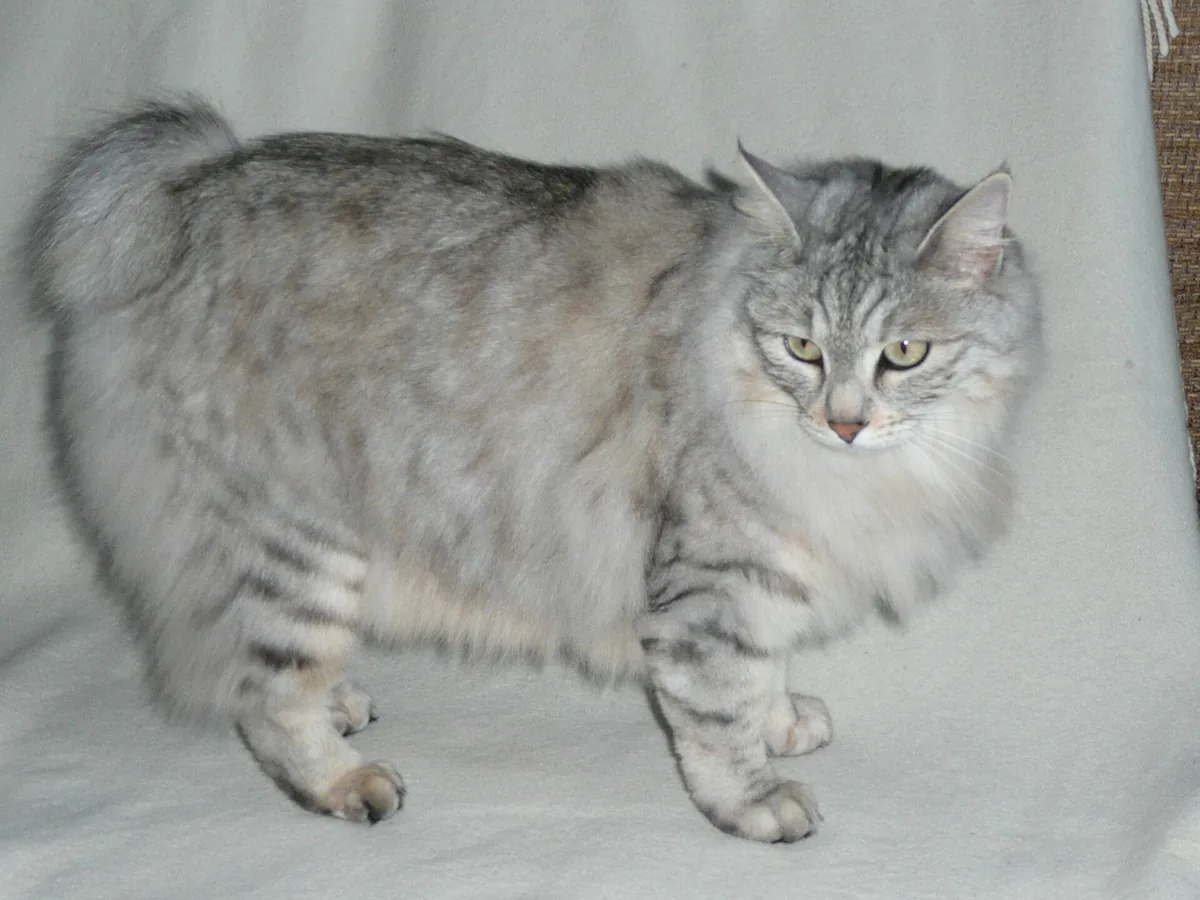
Adults weigh 1.8–3.2 kg and stand 20–25 cm at the shoulder. The body is compact and muscular rather than fine, the head a modified wedge with a square muzzle, the eyes large and round, and the tail one to six inches of kinks and curves. Both coat lengths exist — short and slightly plush, or longer with a light ruff — and pointed colours are the most common, though any colour is allowed.
They stay kittenish without being frantic: a Toybob will chase a toy, then choose the lap instead, and follow its owner from room to room with quiet commentary.
Care essentials
- Grooming
- Almost none: a weekly rub with a soft brush, more often for the longhair in coat change. Small cats groom themselves efficiently, but check the tail base for grease and the ears for wax.
- Exercise & play
- Moderate — twenty minutes of play split into two sessions, plus a low, wide cat tree. Avoid long drops and very high shelves; the short legs and small frame land harder than a big cat's.
- Feeding
- Small stomach, high calorie need per kilo. Feed kitten food to twelve months and use a scale, not the packet: 30–45 g of dry food a day for an average adult, split into three meals.
- Home setup
- Built for flats. Warm, draught-free corners, a covered bed, and steps rather than jumps. Keep breakables off low shelves, since it climbs anything at shoulder height.
Health
- Hypoglycaemia in very small kittens — tiny livers store little glycogen; feed frequently and know the signs (wobbling, drooling, cold)
- Dental crowding — a small jaw with a full set of teeth; tartar and gingivitis appear early
- Patellar luxation — reported in small breeds; watch for a hitch in the gait
- Anaesthetic sensitivity — low body mass makes drug dosing unforgiving; find a vet who weighs and calculates rather than guessing
There is no breed-specific DNA panel; TICA's standard instead advises testing outcross stock for structural mutations and known genetic disease. Ask the breeder for the parents' weights (a Toybob should be small because it is a Toybob, not because it was underfed), patella checks, and dental history.
Health information here is general and not a substitute for veterinary advice. If your cat shows symptoms, contact a vet.
Frequently asked
Is the Toybob a dwarf cat?
No. Dwarf breeds such as the Munchkin carry a cartilage mutation that shortens the legs against a normal-sized body. The Toybob is proportionally small all over, the size of a four-to-six-month-old domestic cat, with normal leg length and bone structure.
How big does a Toybob get?
Most adults weigh 1.8–3.2 kg and stand 20–25 cm at the shoulder; some males stay under 2.5 kg. They reach full size slowly, often still filling out at two years, and the tail is 3–15 cm of kinks.
Are Toybobs good with children?
Better than most tiny breeds, because they are sturdy and tolerant rather than fragile. The limit is handling: a toddler can hurt a 2 kg cat by picking it up, so supervise, teach sitting-down cuddles, and give the cat shelves it can escape to.
Care and health guides
Similar breeds
All breeds →