Karelian Bobtail
卡累利阿短尾猫 · Shorthair & semi-longhair · natural bobtail (Russia) · Russia (Republic of Karelia)
Karelian Bobtails come from the islands and north shore of Lake Ladoga, in the Republic of Karelia, where short-tailed cats have worked as ratters for at least two centuries.
Quick facts
- Weight
- 5.5–13 lb (2.5–6 kg); males 4.5–6 kg, females 2.5–4 kg
- Length
- Body 16–19 in (41–48 cm); tail only 1.6–5 in (4–13 cm)
- Lifespan
- 15–18 years
- Typical price
- $800–2,000 where available; rarely sold outside Russia and Finland
Temperament & lifestyle
About the breed
Karelian Bobtails come from the islands and north shore of Lake Ladoga, in the Republic of Karelia, where short-tailed cats have worked as ratters for at least two centuries. Local belief held that a cat with no tail brought luck to the household. The tail is a natural mutation, and unlike the Kurilian Bobtail's it is recessive — both parents must carry it — which is one reason the two Russian bobtails are now treated as separate breeds rather than regional variants.
St Petersburg felinologists began describing the cats seriously in the 1980s, using about fifteen animals bred by Liliya Dvoryaninovich from the lake's north shore. A first standard was written in 1987, the World Cat Federation recognised the breed in 1994, and it is still shown in two coat lengths: short and dense, or semi-long with a ruff and breeches. Chocolate, cinnamon, their dilutions and the pointed pattern are excluded.
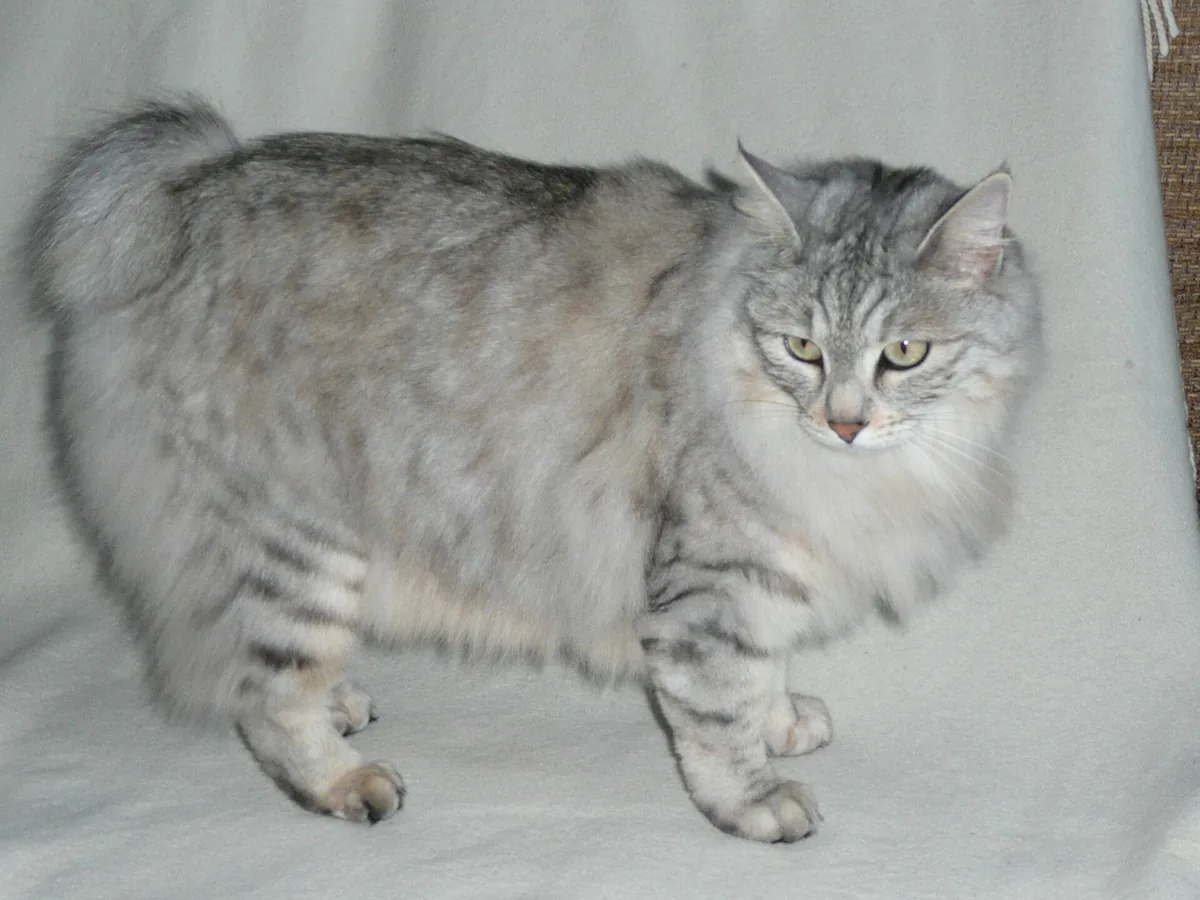
The tail is the signature: 4–13 cm, kinked and bent, no two alike, with longer fur that makes a pom-pom tip. The hind legs are clearly longer than the front, lifting the rump above the shoulders, and the head is an equilateral triangle with a long, almost straight profile.
Care essentials
- Grooming
- Shorthairs need a rubber brush weekly; semi-longhairs need twice weekly, with attention to the armpits, belly and the pom-pom tail, which tangles into a felted knot if skipped. Bathing twice a year is enough.
- Exercise & play
- A working cat's brain in a pet's body. Fifteen minutes of wand play plus puzzle feeders; it will also patrol windowsills and shelves for hours on its own.
- Feeding
- Medium appetite, but the semi-longhair coat hides weight gain — weigh monthly. Around 55–70 g of dry food or 5 oz wet daily for an average adult, less for a sedentary indoor cat.
- Home setup
- Wants vertical space: a ceiling-height tree, shelves, a window perch. Fine in a flat if it can climb. It tolerates cold well but dislikes being shut in one room.
Health
- Hypertrophic cardiomyopathy (HCM) — the usual concern in Russian natural breeds; no published breed-wide screening programme
- Obesity — semi-long coats hide body condition, and indoor cats gain quietly
- Periodontal disease — small jaws and tight tooth spacing; brushing and dental checks from age two
- Tail and sacral defects — the shortened, kinked tail is a skeletal trait; ask whether the breeder has seen constipation or hind-end weakness in the line
There is no DNA test panel specific to the Karelian Bobtail, and health data is thin because the population outside Russia is tiny. Ask for the parents' heart scans, a documented tail structure, and any history of hind-limb problems; have a new kitten examined within 72 hours, with particular attention to tail movement and anal tone.
Health information here is general and not a substitute for veterinary advice. If your cat shows symptoms, contact a vet.
Frequently asked
How is a Karelian Bobtail different from a Kurilian Bobtail?
Origin and genetics. The Karelian comes from Lake Ladoga in Karelia and its short tail is recessive, so both parents must carry it; the Kurilian comes from the Kuril Islands and its tail gene is dominant. They look similar but are treated as separate breeds, and neither is widely kept outside Russia.
Does the short tail cause health problems?
The Karelian's tail is a naturally shortened, kinked spine section rather than the Manx tailless mutation, and serious spinal disease is not a hallmark of the breed. Still, tail and sacral defects are worth asking about, and any kitten with poor anal tone, incontinence or a dragging hind leg should be examined before purchase.
Can I find a Karelian Bobtail outside Russia?
Rarely. Breeding is concentrated in Russia, with a few catteries in Finland and the Baltics, and WCF is the registry that recognises it. Expect to import, with the associated rabies titre, microchip and quarantine paperwork, and expect a wait of a year or more for a kitten.
Care and health guides
Similar breeds
All breeds →