Bombay
孟买猫 · Shorthair · Burmese derivative · Louisville, Kentucky, United States
The Bombay was built to order.
Quick facts
- Weight
- 6–11 lb (2.7–5 kg)
- Length
- 14–17 in body (36–43 cm), tail 11–13 in
- Lifespan
- 12–16 years
- Typical price
- $500–$1,500
Temperament & lifestyle
About the breed
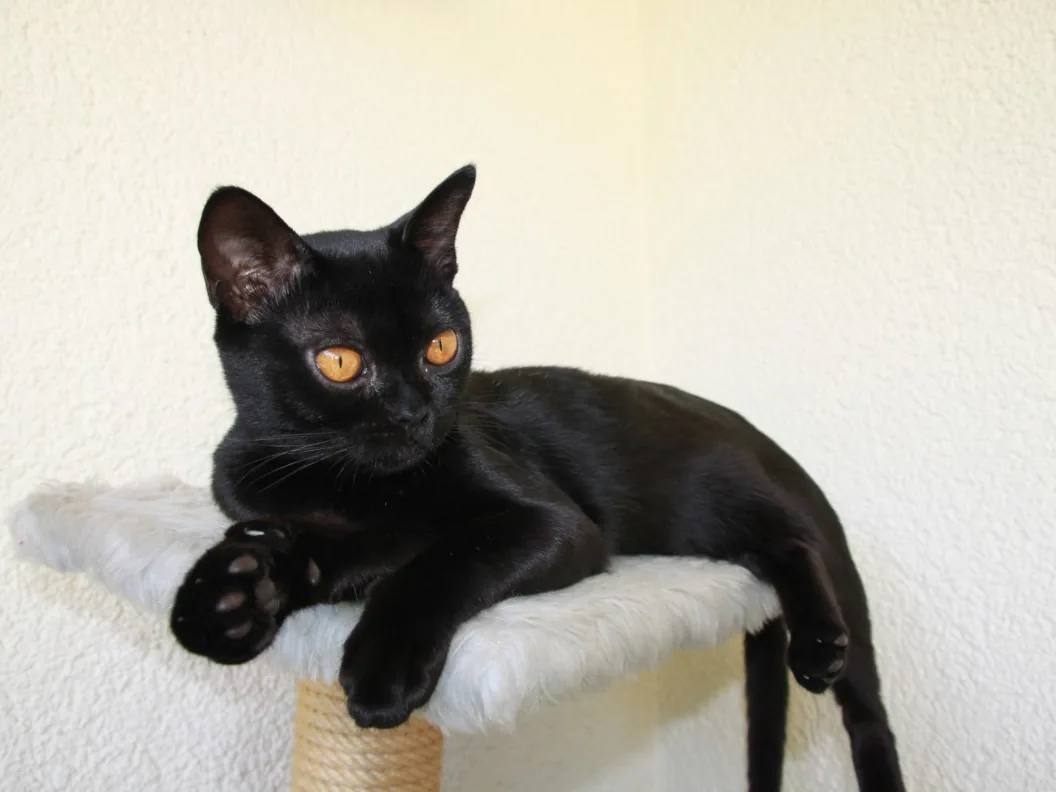
The Bombay was built to order. In 1950s Louisville, Kentucky, breeder Nikki Horner set out to make a miniature black panther: a sable Burmese crossed with a black American Shorthair, selected for a sleek black coat and copper eyes. The first cats were registered with CFA in 1970 and reached championship status in 1976. The name was marketing — Burma and India were imagined as one exotic East — and the breed has never been common, partly because black cats are hard to sell.
The coat is the point: black to the skin, with no lighter undercoat and no brownish tipping, so it reflects light like lacquered wood or patent leather. It is short, close-lying and almost odourless; a rub with a chamois is most of the grooming it needs, and hard brushing dulls the shine. Eyes are copper to gold, nose leather and whisker pads black. Males weigh 8–11 lb (3.6–5 kg). Note the naming trap: the British Bombay is a black Asian/Burmese variant with a finer, more Oriental build — a different cat.
Bombays are social to the point of clinginess: they follow their owner into the bathroom, sleep under the covers, greet guests at the door and behave like a small dog in a cat suit. They get on with children and cat-friendly dogs, tolerate apartment life, and talk in a soft voice rather than a Siamese wail. They hate being left alone all day and do better in pairs. Confident and forgiving, they are among the easier first cats — provided someone is home most of the time.
Care essentials
- Grooming
- A rubber brush or chamois once a week is enough; the single short coat has no undercoat, so shedding is light. Wipe with a damp chamois to lift the sheen. No bathing routine needed, and hard brushing dulls the lacquer finish.
- Exercise & play
- Fifteen to twenty minutes of chase or fetch daily. They are more active than they look and will invent trouble when bored; a cat wheel and puzzle feeders help.
- Feeding
- Prone to weight gain: measure portions, about 1/2 to 2/3 cup dry or 5–6 oz wet a day for an adult. Two meals, with play before food to mimic a hunt.
- Home setup
- Apartment-friendly. Wants a warm perch, a lap and company; a second cat or a settled dog prevents separation stress. Black coats show dust, so wash bedding often and keep lint rollers around.
Health
- Hypertrophic cardiomyopathy (HCM) — inherited through Burmese and American Shorthair lines; ask for echo results on the parents
- Craniofacial deformity (Burmese head defect) — a lethal recessive that appears in Burmese-derived breeds
- Obesity and diabetes — food-motivated and sedentary indoors if not played with
- Gingivitis — reported more often in Burmese-family cats; start tooth brushing young
There is no Bombay-specific screening scheme, so the health of a kitten largely reflects the Burmese and American Shorthair lines behind it. Ask breeders for HCM screening and for the craniofacial-defect history of the line.
Health information here is general and not a substitute for veterinary advice. If your cat shows symptoms, contact a vet.
Frequently asked
Why is my Bombay cat turning brown?
Sun exposure bleaches the coat, and older cats often go rusty around the neck and flanks. It is cosmetic, not a health problem — keep them out of direct sun. Some 'Bombays' are in fact black Burmese crosses with a browner, softer coat.
Are Bombay cats good with dogs?
Usually yes. They are confident, sociable cats that read dog body language well, and they are often described as dog-like themselves. Introduce them slowly and give the cat shelves to escape to.
Do Bombay cats talk a lot?
Often, but quietly — a running commentary of soft meows and chirps rather than a Siamese yowl. Many answer when spoken to and will follow you around mid-sentence.
Are Bombay cats hypoallergenic?
No cat is truly hypoallergenic, and the Bombay is no exception to Fel d 1, the protein that triggers most cat allergies. Low shedding and minimal grooming mean less allergen on surfaces, which helps some people but does not make the breed safe for everyone.