Snowshoe
雪鞋猫 · Shorthair · colourpoint bicolour (United States) · United States (Philadelphia)
The Snowshoe exists because of an accident in a Philadelphia cattery in the 1960s.
Quick facts
- Weight
- 7–12 lb (3.2–5.4 kg)
- Length
- body 16–20 in (41–51 cm), tail 12–14 in
- Lifespan
- 13–15 years
- Typical price
- $500–$1,200 in the US; in China ¥5,000–15,000
Temperament & lifestyle
About the breed
The Snowshoe exists because of an accident in a Philadelphia cattery in the 1960s. A Siamese breeder named Dorothy Hinds-Daugherty had a litter in which three kittens came out with white feet and white on the face; she called them Silver Laces and set out to fix the look, crossing seal point Siamese with bicolour American Shorthairs and then breeding the offspring back to Siamese to recover the points.
Hinds-Daugherty eventually gave up the programme and Vikki Olander carried it, writing the first standard and getting experimental status in 1974. By 1977 Olander was the last Snowshoe breeder in the United States; the breed survived on a handful of enthusiasts. Championship status came with the CFF in 1983, ACFA in 1990 and TICA in 1993, with full FIFe recognition in 2004. It is still rare — FIFe registered 35 Snowshoe kittens in 2024, 0.04% of its total.
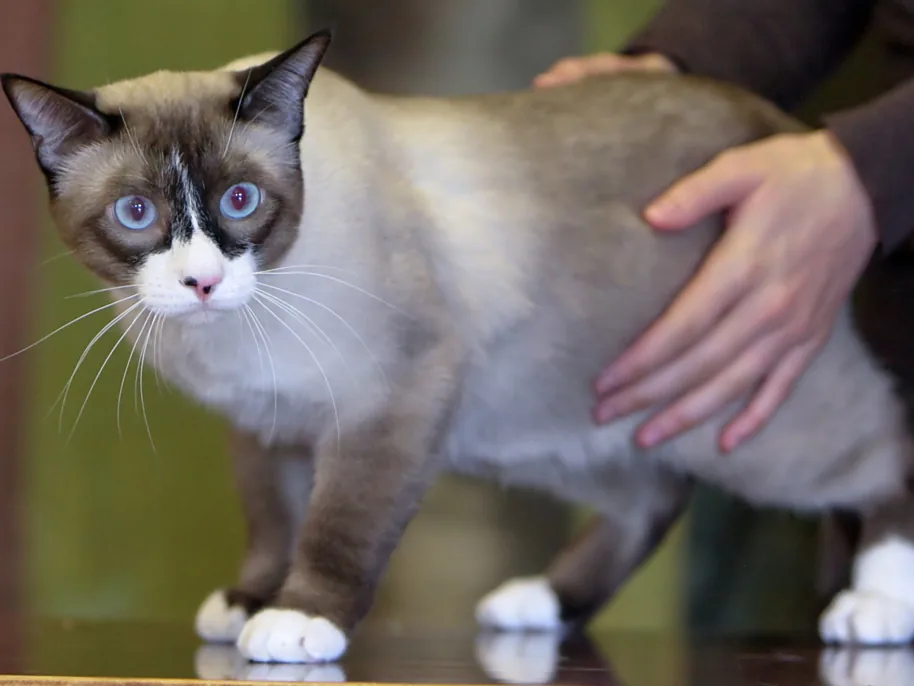
The look is a pointed cat wearing white gloves and a white inverted V on the muzzle, on a medium, athletic body that is longer and less cobby than an American Shorthair. Eyes are always blue. Getting the white in exactly the right places is difficult, which is the main reason the breed stayed small.
Care essentials
- Grooming
- Brush twice a week with a rubber curry; the single short coat is easy but sheds steadily onto dark furniture. White feet show litter and garden dirt, so check and wipe paws rather than bathing often.
- Exercise & play
- Active without being frantic: fifteen to twenty minutes of wand play plus a climbing tree, and it will invent its own games with bottle caps if bored.
- Feeding
- Moderate appetite, tendency to pick at food rather than gorge — two or three small meals suit it better than one bowl. Keep wet food in the rotation for urinary health.
- Home setup
- Wants company and vertical space. A flat is fine if someone is home most of the day; a household out from nine to six should have a second cat or a very good cat sitter.
Health
- Hypertrophic cardiomyopathy (HCM) — reported in the breed and in its Siamese ancestry; echo-screen parents
- Urate urolithiasis — Snowshoes were over-represented in a review of over 5,000 urinary stone cases
- Dental disease — tartar and gingivitis build up early; brush teeth and book dentals
- Crossed eyes and kinked tails inherited from old Siamese lines — cosmetic, not painful
The gene pool is small and the breed is genuinely rare, so ask how much outcrossing a line has had and whether the cattery has inbreeding coefficients on file. Request HCM echoes on both parents, feed wet food with plenty of water, and have urine checked at annual visits. Cross-eyed or kinked-tail kittens are perfectly healthy pets and usually sold cheaper.
Health information here is general and not a substitute for veterinary advice. If your cat shows symptoms, contact a vet.
Frequently asked
Why are Snowshoe cats so hard to find?
Because the white markings are genetically fiddly — most kittens from a Snowshoe pairing come out with too much or too little white, so few qualify for breeding. FIFe registered only 35 Snowshoe kittens worldwide in 2024, which makes waiting lists normal and impulse buying impossible.
Is a Snowshoe just a Siamese with white feet?
No — it is a separate breed built from Siamese and bicolour American Shorthair, with a longer, heavier body than a modern Siamese and a different standard. The white gloves and the inverted V on the face are required, not optional, and the eyes must be blue.
Do Snowshoes get lonely?
They are among the more people-dependent breeds and cope badly with long empty days. Left alone from morning to evening they may over-groom, call constantly or start missing the litter tray. A second cat, a midday visit, or a household that is home during the day suits them far better.