Birman
伯曼猫 · Semi-longhair colourpoint · Myanmar (legend); established in France
The Birman comes with one of the most elaborate origin myths in the cat world: temple cats of Lao-Tsun in Burma, a golden-skinned goddess with sapphire eyes, a priest killed defending the sanctuary, and a white cat whose paws turned white where they touched its dying master while its eyes took on the colour of the goddess.
Quick facts
- Weight
- Males 4.5-6 kg, females 3-4.5 kg
- Length
- Body 38-46 cm; silky plumed tail
- Lifespan
- 12-16 years
- Typical price
- US$800-2,000
Temperament & lifestyle
About the breed
The Birman comes with one of the most elaborate origin myths in the cat world: temple cats of Lao-Tsun in Burma, a golden-skinned goddess with sapphire eyes, a priest killed defending the sanctuary, and a white cat whose paws turned white where they touched its dying master while its eyes took on the colour of the goddess. The documented history is thinner but still romantic - a pair of cats shipped from Burma to France in 1919, of which only a pregnant female survived the voyage.
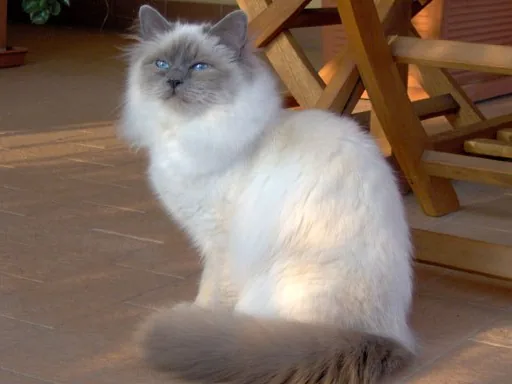
After the Second World War the French breeding population was reduced to a single pair, and the modern breed descends from that bottleneck, rebuilt with careful outcrossing to Persian and Siamese lines. The result is a semi-longhaired cat with a colourpoint pattern and, crucially, symmetrical white gloves on all four paws - a feature no other pointed breed has, and one that is genetically separate from the white spotting seen in other cats.
The coat is silky rather than woolly, so it hangs close to the body and rarely mats; a full ruff develops around the neck and the tail plumes out. The body is longer than the Siamese's, with a broad, rounded head, medium ears and deep blue eyes. Birmans are the gentlest of the pointed breeds. They are quiet, tolerant, dislike being alone, and get along with children, dogs and other cats with unusual ease. Males weigh 4.5-6 kg, females 3-4.5 kg. Expect a cat that wants to be in the same room as you, ideally on you, without demanding it loudly.
Care essentials
- Grooming
- The silky coat is forgiving: comb twice a week with a stainless steel comb, and pay attention to the ruff, armpits and the area behind the hind legs, where the coat is densest. There is little undercoat, so matting is uncommon, but seasonal shedding still needs a daily pass for a week or two. Bathe every two to three months with a gentle shampoo. Keep the white paws clean and check between the toes.
- Exercise & play
- Moderate. Birmans play in bursts rather than marathons - a couple of fifteen-minute wand sessions and a cat tree at window height satisfy them. They are not natural athletes and rarely jump to dangerous heights, so low, stable platforms work better than a towering tree. Food puzzles keep the brain engaged.
- Feeding
- Standard high-protein cat food, measured, in two meals. Birmans are prone to putting on weight in middle age because they are inactive indoors; weigh monthly. Wet food once a day supports urinary health, which matters in a breed that drinks little. Kittens grow steadily rather than fast, so there is no need to push calories.
- Home setup
- Excellent apartment cat - quiet, clean and undemanding of space. It needs company more than square metres: if you work long hours, consider a second cat. Provide a warm sleeping spot, a window and soft bedding. Keep the home calm; this cat withdraws rather than complains when stressed, so behaviour changes are easy to miss.
Health
- Hypertrophic cardiomyopathy (HCM) - the main inherited risk, screened by breeders
- Polycystic kidney disease (PKD) - inherited, DNA and ultrasound screening available
- Congenital hypotrichosis - rare, kittens born with sparse or missing coat
- Dermoid cysts - occasionally on the cornea or skin, present from birth
- Spina bifida - rare but documented in the breed
HCM and PKD are the two questions worth asking about by name. Birmans are otherwise robust and famously long-lived for their size. Because they hide illness and dislike complaint, annual vet checks with bloodwork after age seven catch kidney and thyroid changes early.
Health information here is general and not a substitute for veterinary advice. If your cat shows symptoms, contact a vet.
Frequently asked
Do Birman cats always have white paws?
Yes - symmetrical white gloves on all four paws are mandatory in the breed standard and are the Birman's defining feature. The gloves should end in a clean line at the joint, with white extending up the back of the hind leg into a point. A kitten born without gloves is not registerable as a Birman.
Is a Birman the same as a Siamese?
No, though they share the colourpoint gene. The Birman is heavier and longer, has a semi-long silky coat, deep blue eyes and white gloves; the Siamese is a slender shorthair with a wedge head and no white. Temperament differs too - Birmans are quiet and placid, Siamese are loud and demanding.
Do Birmans need a lot of grooming?
Less than most longhairs. The coat has little undercoat, so it lies flat and resists matting. Two combing sessions a week keep it in condition, with a short daily pass during shedding season. The main jobs are keeping the ruff untangled and the white paws clean.
Are Birman cats good apartment cats?
Very good. They are quiet, rarely destructive, and do not need outdoor access. The limiting factor is company, not space: Birmans become anxious and withdrawn when left alone for long stretches. A window, a cat tree and either a second cat or a work-from-home routine make an apartment ideal.