Savannah
萨凡纳猫 · Hybrid / Foundation breed · United States (Pennsylvania)
The Savannah is a hybrid: a domestic cat crossed with the African serval (Leptailurus serval).
Quick facts
- Weight
- 8–20 lb (3.6–9 kg), higher in early generations
- Length
- Tall and long-legged; 17–22 in (43–56 cm) nose to tail base, shoulder height up to 17 in
- Lifespan
- 12–20 years
- Typical price
- $1,500–3,000 typical; F1 kittens $10,000–20,000+
Temperament & lifestyle
About the breed
The Savannah is a hybrid: a domestic cat crossed with the African serval (Leptailurus serval). The first recorded litter was born in 1986 in Pennsylvania, when breeder Judee Frank's serval mated a Siamese queen; a female named Savannah, behind most modern lines, gave the breed its name. TICA accepted the breed for registration in 2001 and for championship in 2012. CFA does not recognise it, because CFA does not accept hybrid breeds. Generations run F1 to F5: an F1 is roughly half serval, and males are usually only reliably fertile from F5 onward.
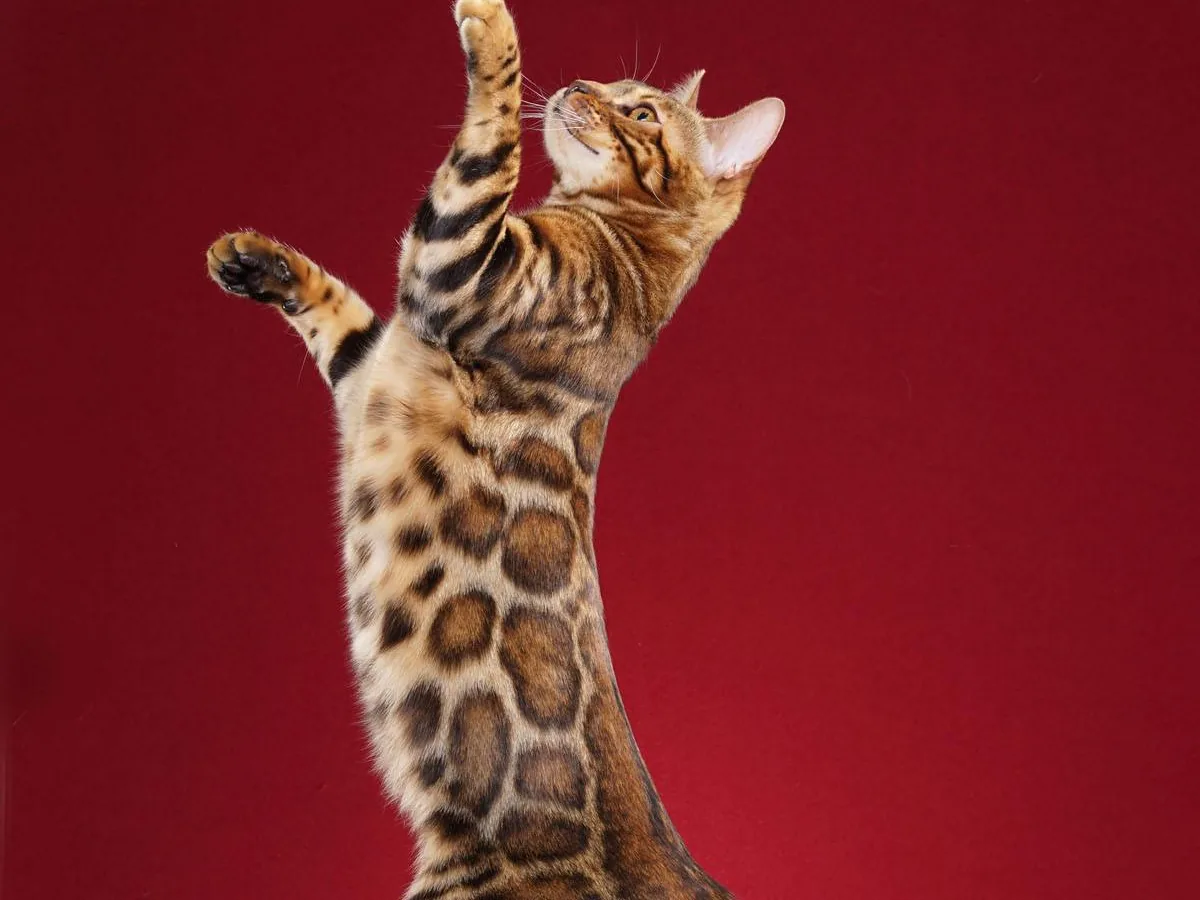
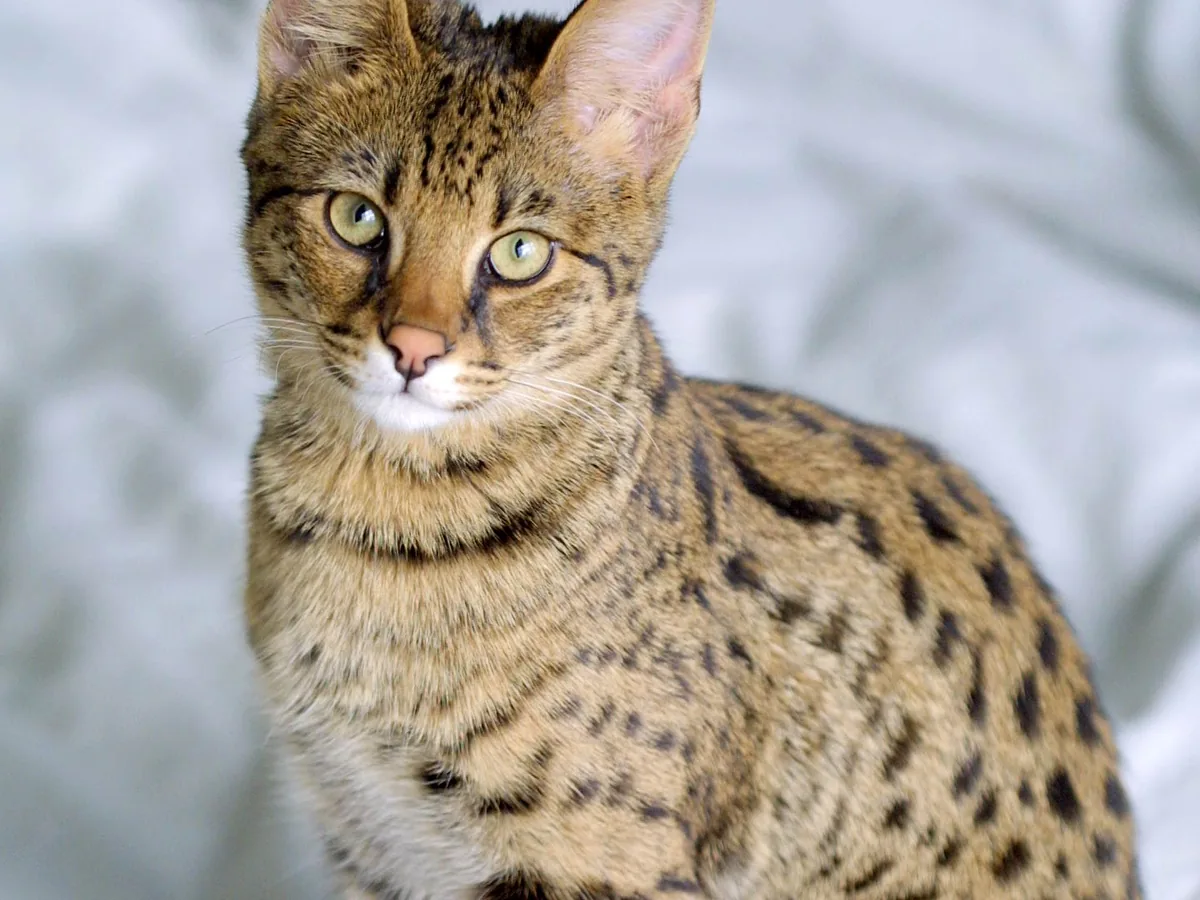
The look follows the serval — tall legs, a long neck, big upright ears set high on a small head, and bold black spots on a golden, silver or smoke ground. Size swings enormously with generation. An F1 can exceed 20 lb and stand 17 inches at the shoulder; later generations sit closer to a large domestic cat at 8–14 lb.
The temperament is busy. Savannahs are athletic, fascinated by water, and interested in everything; they open doors, learn leash walking, and jump from a standstill to the top of a door frame. They are affectionate on their own terms and often dislike being held. A bored Savannah is loud and destructive, and boredom is the most common reason they are rehomed — research both the generation and the local law before buying, because ownership is restricted in several countries and states.
Care essentials
- Grooming
- Simple. The short spotted coat needs a weekly rub with a rubber curry or chamois; there is almost no undercoat. Check ears and teeth weekly and trim claws every two weeks. No bathing unless the cat is genuinely dirty.
- Exercise & play
- Extreme by cat standards. Plan on at least an hour of structured play a day, plus cat wheels, ceiling-high climbing routes, puzzle feeders and leash walks in a secure area. Without an outlet they redecorate the house.
- Feeding
- High-protein, portion-controlled food, ideally raw or wet-inclusive, split across two or three meals. Avoid free-feeding — these cats stay lean only if intake is managed. Some Savannahs have sensitive digestion, so change foods slowly over 7–10 days.
- Home setup
- A secure catio or fully fenced garden is close to essential, and windows must be screened with reinforced mesh. They need vertical territory and things to hunt. Before buying, check the law: Australia banned imports in 2008 and Hawaii prohibits the breed, and several US states and cities require permits or ban F1–F4 cats outright. Because the serval is CITES Appendix II, moving an early-generation cat across borders can require CITES paperwork.
Health
- Hypertrophic cardiomyopathy (HCM) — the most serious known risk, with sudden death reported in young early-generation cats
- Progressive retinal atrophy (PRA) — inherited and testable in some lines
- Erythrocyte pyruvate kinase (PK) deficiency — inherited anaemia; a DNA test is available
- Digestive sensitivity and food intolerance, frequently reported by owners
- Pica and foreign-body ingestion — high curiosity plus a strong chew drive leads to intestinal surgery
Ask for the generation, the full pedigree and any DNA results, and have the kitten examined by a vet who has seen hybrid breeds. Breeding cats should have annual echocardiograms; a normal DNA test does not rule out HCM. Legal status matters as much as health: ownership is restricted or banned in parts of Australia, in Hawaii and in several US states and municipalities, and early generations may need CITES documentation to cross borders. Insure early — hybrid exclusions are common.
Health information here is general and not a substitute for veterinary advice. If your cat shows symptoms, contact a vet.
Frequently asked
Is a Savannah cat legal where I live?
It depends on the generation and the jurisdiction. Australia banned imports in 2008, Hawaii prohibits the breed, and several US states and cities require permits or ban F1–F4 cats. Check with your state agriculture department and local animal control before paying a deposit.
Do Savannah cats use a litter box?
Yes — later generations (F5 and beyond) are straightforward with litter. Early generations may spray or mark, and intact males of any generation are more likely to. Use a large box with an unscented clumping litter and clean it twice a day.
Are Savannahs good with children and other pets?
They can be, if the child respects the cat's space and the cat has escape routes. Their energy can overwhelm small children, and they may chase small pets. Large, calm dogs usually work; birds, hamsters and fish do not.
How much does a Savannah cat cost?
Later-generation pets typically run $1,500–3,000. F1 and F2 kittens are far more expensive — often $10,000–20,000 — because litters are small and difficult to produce. Cheap Savannahs are usually mislabelled later generations, so insist on pedigree papers.