Oriental Longhair
东方长毛猫 · Semi-longhair · Oriental type (Siamese family) · United Kingdom / United States
The Oriental Longhair is the Oriental Shorthair with the long-hair gene switched on — one recessive allele, so breeding a longhair to a shorthair or a Siamese produces an all-shorthair litter of carriers.
Quick facts
- Weight
- 8–12 lb (3.5–5.5 kg)
- Length
- Body 18–20 in (45–52 cm), whippy tail 12–14 in (30–36 cm)
- Lifespan
- 12–15 years
- Typical price
- $600–$1,500 in the US; €600–1,200 in Europe
Temperament & lifestyle
About the breed
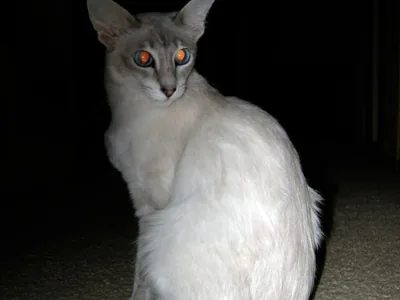
The Oriental Longhair is the Oriental Shorthair with the long-hair gene switched on — one recessive allele, so breeding a longhair to a shorthair or a Siamese produces an all-shorthair litter of carriers. British breeders developed it from Siamese and Oriental stock and called it the British Angora until 2002, when the name was dropped to end the endless confusion with the Turkish Angora. Other registries have used Foreign Longhair, Mandarin and, confusingly, Javanese. CFA treats it as a division of a merged Oriental breed rather than a breed of its own.
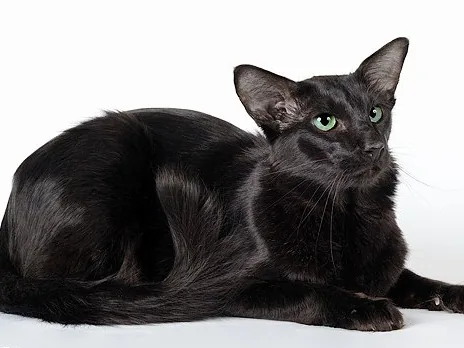
Everything about the cat is long and narrow: a tubular body on tall legs, a wedge head with huge ears set low and wide, a whippy tail, and a silky, close-lying coat with almost no undercoat. Green eyes are preferred except in whites. Once patterns and white markings are counted, the colour range runs to hundreds of combinations, and kittens in one litter can come out completely different.
Temperament is intense. These cats talk constantly, demand involvement, learn tricks and walk on a lead, and dismantle a quiet room out of boredom. They are not decorative, and they are not happy alone.
Care essentials
- Grooming
- A steel comb twice a week is enough; the single silky coat has almost no undercoat, so it rarely mats despite the length. Check the tail and behind the ears, and expect very little shedding.
- Exercise & play
- High energy that needs a job: twenty to thirty minutes of active play, puzzle feeders, clicker training and vertical routes. Without an outlet it will redecorate, and no closed door is truly closed.
- Feeding
- Lean and active, so feed to condition: about 1/2–2/3 cup dry or 5–6 oz wet daily in two meals. It burns calories quickly but will still overeat out of boredom, so use feeders rather than a full bowl.
- Home setup
- Warm, busy, interactive homes with height and things to climb. It dislikes being shut away and needs company — a second cat of similar energy, or a dog that tolerates cats, prevents most behaviour problems.
Health
- Hepatic amyloidosis (AA) — the Siamese family's most serious inherited risk; protein deposits destroy the liver, often with little warning
- Hypertrophic cardiomyopathy (HCM) — reported across the Oriental group; echo-screen breeding cats
- Progressive retinal atrophy — late-onset blindness documented in Oriental and Siamese lines
- Dental disease — gingivitis, tartar and tooth resorption are common from early middle age
- Sensitivity to anaesthesia — the breed group needs careful drug protocols
This is a Siamese-family cat, so its risks are the family's risks rather than breed-specific ones. Ask for HCM echoes, PRA status where tested, and a dental history; keep the cat lean, since obesity worsens both heart and joint outcomes. Any unexplained weight loss or jaundice in an Oriental should be investigated for amyloidosis promptly.
Health information here is general and not a substitute for veterinary advice. If your cat shows symptoms, contact a vet.
Frequently asked
Is the Oriental Longhair just a long-haired Oriental Shorthair?
Genetically yes: the same cat with one recessive long-hair allele. Coat length is the only difference, and breeding a longhair to a shorthair produces an all-shorthair litter of carriers — which is why the two are shown as divisions of one breed in CFA and as separate breeds in TICA.
Why was it called the British Angora?
Because British breeders developed it and named it for the Angora type, which caused decades of confusion with the Turkish Angora. The name was dropped in 2002. The older names Foreign Longhair and Mandarin persist in some registries, and in WCF the same cat is registered as the Javanese.
Are Oriental Longhairs difficult first cats?
They are demanding rather than difficult. The coat is easy and the cat is friendly, but it needs hours of company, conversation and play, and it vocalises loudly. A household that is out all day should either take two or choose a calmer breed; a bored Oriental is destructive and noisy.