Neva Masquerade
涅瓦伪装猫 · Semi-longhair · Siberian colourpoint branch · Russia (St Petersburg)
The Neva Masquerade takes its name from the Neva river and St Petersburg, where the colourpoint version of the Siberian landrace appeared in the 1970s and 80s.
Quick facts
- Weight
- 10–20 lb (4.5–9 kg); males at the top of the range
- Length
- Body 19–24 in (48–60 cm), bushy tail 12–14 in (30–36 cm)
- Lifespan
- 12–15 years
- Typical price
- $800–$2,500 in the US; €700–1,600 in Europe
Temperament & lifestyle
About the breed
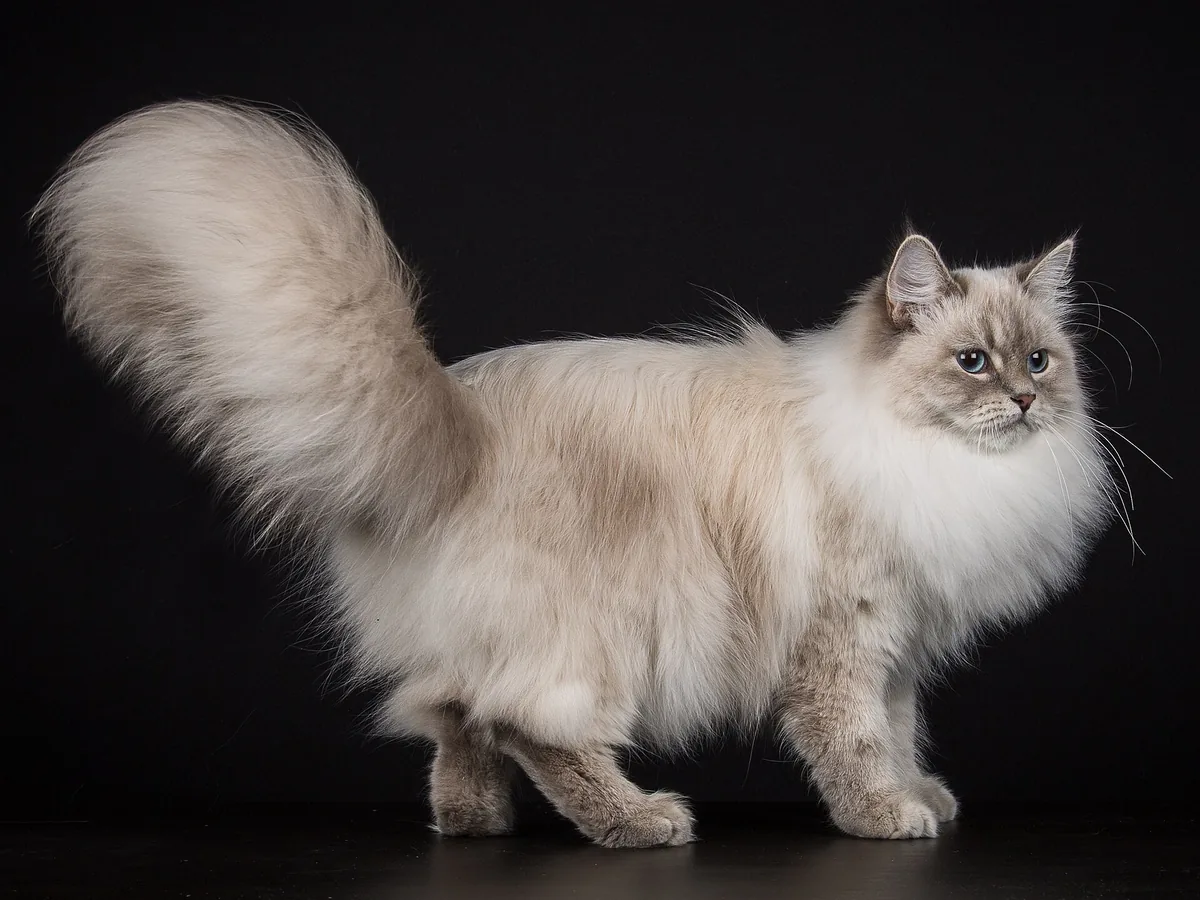
The Neva Masquerade takes its name from the Neva river and St Petersburg, where the colourpoint version of the Siberian landrace appeared in the 1970s and 80s. Russian breeders believe colourpoint cats of Asian origin, or their descendants, were crossed into the long-established Siberian forest cat, deliberately or not. What came out is a Siberian in a Siamese mask: the same triple coat, barrel body and bushy tail, but a pale body with darker points and, always, blue eyes. Kittens are born nearly white and darken with age; cold weather deepens the points even in adults.
The registries disagree about what it is. FIFe and WCF list the Neva Masquerade as a separate breed, while TICA and CFA treat the colourpoint pattern as a permitted Siberian colour. It is the same cat either way, and the two are freely interbred in most registries.
That matters for health. Traditional Siberians have almost no polycystic kidney disease; PKD has been diagnosed in Neva Masquerade lines and confirmed as inherited, most likely via colourpoint Persian ancestry. HCM is the other concern. Siberians mature at four to five years and males reach 9 kg, so budget for a large, late-maturing cat.
Care essentials
- Grooming
- Comb two or three times a week and daily during the spring and autumn moult; the triple coat has a dense underlayer that felts in the armpits and behind the hind legs. A metal comb, not a slicker, reaches the skin.
- Exercise & play
- Moderate: fifteen to twenty minutes of play plus tall climbing furniture. It is a powerful jumper and needs somewhere legal to land, or the top of the fridge becomes the landing zone.
- Feeding
- A large, slow-maturing cat: 6–8 oz wet or 2/3 cup dry daily, more for an intact male in winter. Feed to body condition, not to the packet, and expect appetite to rise in cold weather.
- Home setup
- Suits flats if given height and a scratching post it can pull against. It wants company and a cool room in summer; the triple coat means overheating is a bigger risk than chill, and a warm radiator bed is a mistake.
Health
- Polycystic kidney disease (PKD) — diagnosed in Neva Masquerade lines and confirmed inherited, unlike in traditional Siberians
- Hypertrophic cardiomyopathy (HCM) — the main cardiac concern in the Siberian group; annual echo for breeding cats
- Hip dysplasia — reported in the wider Siberian population; watch for a stilted gait or reluctance to jump
- Obesity — a large, calm, indoor cat that gains weight slowly and keeps it
- Dental disease — tartar and gingivitis from middle age
Because PKD is present in this branch but essentially absent from traditional Siberians, mixing the two without testing risks spreading it — the single most useful question to ask a breeder is the PKD status of both parents, by DNA test or ultrasound. Add HCM echoes and hip assessment, and note that the breed matures at four to five years, so adult-size problems surface late.
Health information here is general and not a substitute for veterinary advice. If your cat shows symptoms, contact a vet.
Frequently asked
Is the Neva Masquerade a separate breed or just a pointed Siberian?
Both answers are officially in use. FIFe and WCF register it as a separate breed, while TICA and CFA accept the colourpoint pattern as one of the Siberian's permitted colours. Genetically and temperamentally it is a Siberian with the colourpoint gene, and most registries allow the two to be crossed.
Why do Neva Masquerade kittens look almost white?
The colourpoint gene produces a heat-sensitive enzyme, so pigment only develops on the cooler extremities and the body stays pale. Kittens are born near-white and darken over two to three years; cold weather deepens the points further, even in adult cats, and a cat kept warm will look lighter.
Do Neva Masquerades have more health problems than Siberians?
In one specific way, yes: PKD has been found in Neva Masquerade lines and confirmed as inherited, while traditional Siberians are essentially free of it — most likely because of colourpoint Persian ancestry. HCM and hip dysplasia are shared concerns. Ask for PKD testing on both parents before buying.