Munchkin
曼基康矮脚猫 · Shorthaired / Short-legged · Louisiana, United States (1983)
The Munchkin descends from Blackberry, a short-legged black cat found in Rayville, Louisiana, in 1983 and named by her rescuer, Sandra Hochenedel.
Quick facts
- Weight
- 2.7-4 kg (6-9 lb)
- Length
- Normal body on short legs, about 40-45 cm nose to tail base
- Lifespan
- 12-15 years reported, long-term data still limited
- Typical price
- USD 1,000-2,500; recognised colours and coat lengths cost more
Temperament & lifestyle
About the breed
The Munchkin descends from Blackberry, a short-legged black cat found in Rayville, Louisiana, in 1983 and named by her rescuer, Sandra Hochenedel. A local cat fancier, Kay LaFrance, bred her, and the trait proved to be a simple dominant - pseudoachondroplasia - so short-legged kittens appear whenever one short-legged parent is used. Similar cats were recorded in Britain in the 1930s and in Russia, but no breed came of them. TICA recognised the Munchkin in 2003; CFA and the GCCF do not recognise it.
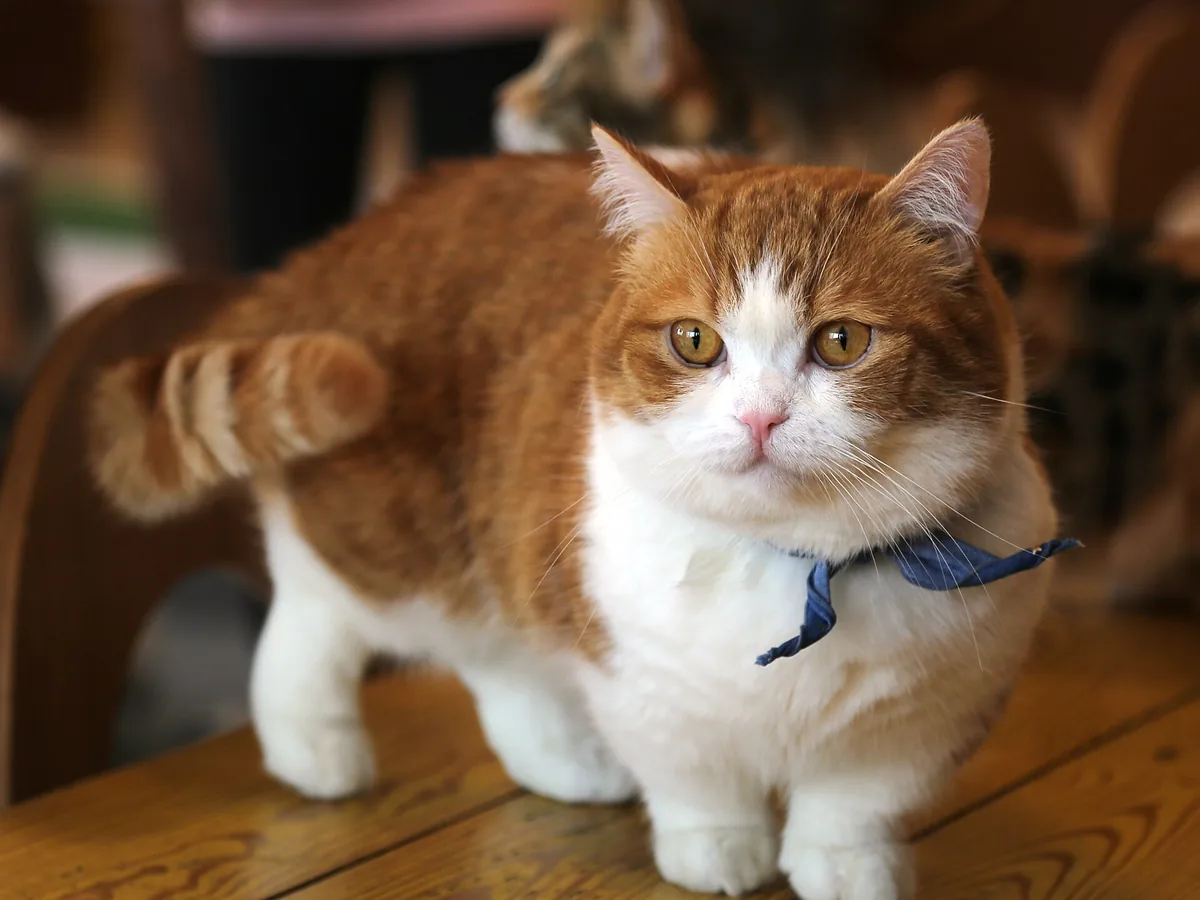
The legs are roughly a third shorter than normal, slightly bowed at the front, while the rest of the body is ordinary. The breed comes in every colour and both coat lengths, and the short legs do not stop cats climbing, running or hunting - owners regularly report Munchkins on top of bookcases. Weight is 2.7-4 kg. Two short-legged cats are never bred together, because the homozygous form is generally considered lethal before birth; every litter therefore contains some normal-legged kittens.
The controversy is real. Critics argue that selecting for a cartilage defect which reshapes the whole skeleton is a welfare problem, and vets do see more spinal curvature and joint disease in short-legged cats. Defenders point to a breed health survey that found few spontaneous problems and to the fact that Munchkins run and jump well. Either way, buyers should ask for health screening of the parents, keep the cat lean, and provide ramps and low-sided boxes so the short legs are never forced to drop from height.
Care essentials
- Grooming
- Shorthaired Munchkins need a weekly rubber brush and little else; longhaired ones need combing three times a week, daily in shed. Check the belly, legs and paws for matting, and keep claws trimmed because short legs mean the claws reach the floor more often.
- Exercise & play
- Moderate. Ten to fifteen minutes of play twice a day, plus floor-level toys and a low cat tree. Avoid encouraging jumps down from high surfaces; use ramps, steps and cushions instead.
- Feeding
- Strict portion control - excess weight is the single biggest avoidable load on a shortened skeleton. Feed measured meals, mostly wet food, and weigh monthly. Do not free-feed.
- Home setup
- Low, accessible furniture, ramps to the sofa and bed, a shallow litter box, and soft landings. Keep the cat indoors; a short-legged cat cannot outrun a dog, a car or a fox.
Health
- Lordosis - excessive inward curvature of the spine, reported in short-legged kittens
- Pectus excavatum - a concave chest wall that can press on the heart and lungs
- Osteoarthritis and joint disease from altered biomechanics of the shortened limbs
- Obesity, which multiplies stress on altered joints
- Breeding lethality - the homozygous short-leg state is considered non-viable
The breed is young and breed-wide health data is thin, so screening matters more than reputation. Ask for parents' X-rays and vet records, inspect the chest and spine shape, and watch the kitten run and turn. Keep the cat indoors and lean; report any reluctance to jump or stiffness early.
Health information here is general and not a substitute for veterinary advice. If your cat shows symptoms, contact a vet.
Frequently asked
Is it cruel to breed Munchkin cats?
It is contested. Critics say selecting for a cartilage defect that shortens every limb is a welfare issue; breed clubs argue the cats move, jump and live normally. Several registries, including CFA and GCCF, refuse recognition. Buy only from breeders who screen and will show you the parents.
Do Munchkin cats have health problems?
The documented risks are spinal curvature, pectus excavatum and joint disease, though breed surveys report few severe cases. The bigger practical risk is obesity, because extra weight loads a shortened skeleton. Insurance and vet checks are worth it.
Can Munchkin cats jump?
Yes, just not as high. They jump onto sofas and low tables easily and often climb via scratching posts and shelves. They should not be expected to leap down from wardrobes; provide steps or ramps instead.
How big do Munchkin cats get?
Body size is normal - 2.7-4 kg - with only the legs shortened by about a third. They are not miniature cats, and their torso, head and tail are the same as any other domestic cat's.