Japanese Bobtail
日本短尾猫 · Shorthair (natural breed) · Japan; documented for over 1,000 years, first US imports 1968
The Japanese Bobtail has been documented in Japan for at least a thousand years.
Quick facts
- Weight
- 6–9 lb (2.7–4.1 kg)
- Length
- 12–16 in (30–41 cm) nose to tail base
- Lifespan
- 12–16 years
- Typical price
- $600–$1,200 (waiting lists common)
Temperament & lifestyle
About the breed
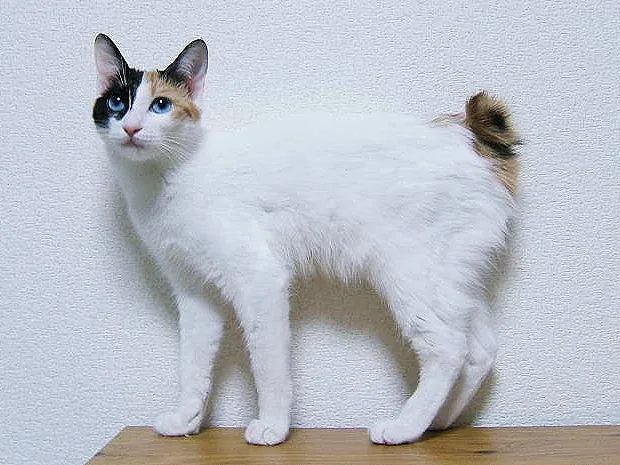
The Japanese Bobtail has been documented in Japan for at least a thousand years. It appears in woodblock prints, temple carvings and the painted cats with one raised paw that became the maneki-neko lucky cat still sold in shops today. Unlike the Manx, whose taillessness comes from a dominant gene that can cause spinal defects, the Japanese Bobtail's short tail is recessive and harmless: a flexible, kinked appendage roughly three inches long, covered in long hair so it reads as a pom-pom or a rabbit's tail. Because the gene is recessive, two bobtails bred together always produce bobtails.
The body is a study in angles — long, slim and muscular, with a high rear, a straight back and long legs — yet the breed rarely exceeds nine pounds. The head is a long triangle with high cheekbones, large oval eyes and big, upright ears. The tricolor mi-ke (white with bold red and black patches) is the classic and, in Japan, the luckiest color; the breed also comes in solid, tabby and bicolor. The coat is medium-length, soft and lies flat, with almost no undercoat.
Temperament is unusually interactive. Bobtails talk — a running commentary of chirps and meows — and they are known for carrying toys in their mouths, fetching, and learning to sit on command. Many like water, ride on shoulders, and are patient enough for children. This is not a lap ornament: it wants to be involved in whatever you are doing, and it will complain loudly when a door closes in its face.
Care essentials
- Grooming
- Minimal. A rubber curry brush or a fine comb once a week removes loose hair; the single coat has little undercoat to mat. No bath needed unless the cat gets into something. Check the tail — the kink can trap debris and, in older cats, the skin folds under it need a look.
- Exercise & play
- Moderate to high. Twenty to thirty minutes of active play daily, plus vertical space: cat trees, shelves, a window perch. Bobtails will invent games if bored, and a bored bobtail reorganizes your shelves.
- Feeding
- Standard cat food, measured. The breed is food-motivated and stays slim only if portions are controlled — 1/4 to 1/2 cup of dry food twice daily for an average adult, adjusted to body condition. No breed-specific dietary needs.
- Home setup
- Indoor or secure outdoor enclosure. It climbs and jumps well and will get onto the highest shelf in the room, so secure breakables. It wants company; a second cat is a good idea if the household is empty during the day.
Health
- No tail-related spinal disease — the bobtail gene is recessive and benign, unlike the Manx gene
- Patellar luxation, seen occasionally and usually mild
- Obesity — the breed is food-motivated and begs convincingly
- Hypertrophic cardiomyopathy, reported but uncommon
- Dental tartar, especially in older cats fed only soft food
This is one of the hardier pure breeds; most bobtails reach 14 or older without major intervention. The important point for buyers is the tail: a genuine Japanese Bobtail has a flexible, kinked tail with normal vertebrae, not the shortened spine of a Manx, and no associated incontinence or hind-leg weakness. Ask to see both parents and the kitten's tail moving.
Health information here is general and not a substitute for veterinary advice. If your cat shows symptoms, contact a vet.
Frequently asked
Do Japanese Bobtails have health problems because of their tail?
No. The short tail comes from a recessive gene that affects only tail length; the vertebrae are normal and flexible. Unlike the Manx, there is no link to spinal bifida, incontinence or hind-leg weakness.
Are Japanese Bobtails hypoallergenic?
No cat is truly hypoallergenic. Bobtails have a single coat with little undercoat and shed modestly, which some allergic owners tolerate better, but the allergen Fel d 1 is still in their saliva and skin.
Do Japanese Bobtails talk a lot?
Yes. They are one of the chattier breeds, but the sound is a chirp, trill or short comment rather than a loud Siamese-style yowl. They narrate arrivals, meals and anything they think you should fix.
How much does a Japanese Bobtail cost?
Around $600–$1,200 in the US, and waiting lists are normal because litters are small and few breeders work with the breed. Tricolor mi-ke kittens cost more, and importing from Japan adds shipping and quarantine costs.