American Curl
美国卷耳猫 · Longhair and Shorthair (curl-eared) · United States (Lakewood, California)
Every American Curl descends from one stray.
Quick facts
- Weight
- 2.3-4.5 kg (5-10 lb); females 2.3-3.6 kg, males 3.2-4.5 kg
- Length
- Body 35-42 cm nose to tail base; tail 25-30 cm
- Lifespan
- 12-16 years
- Typical price
- CNY 8,000-20,000 in China; the breed is rare and most kittens are imported
Temperament & lifestyle
About the breed
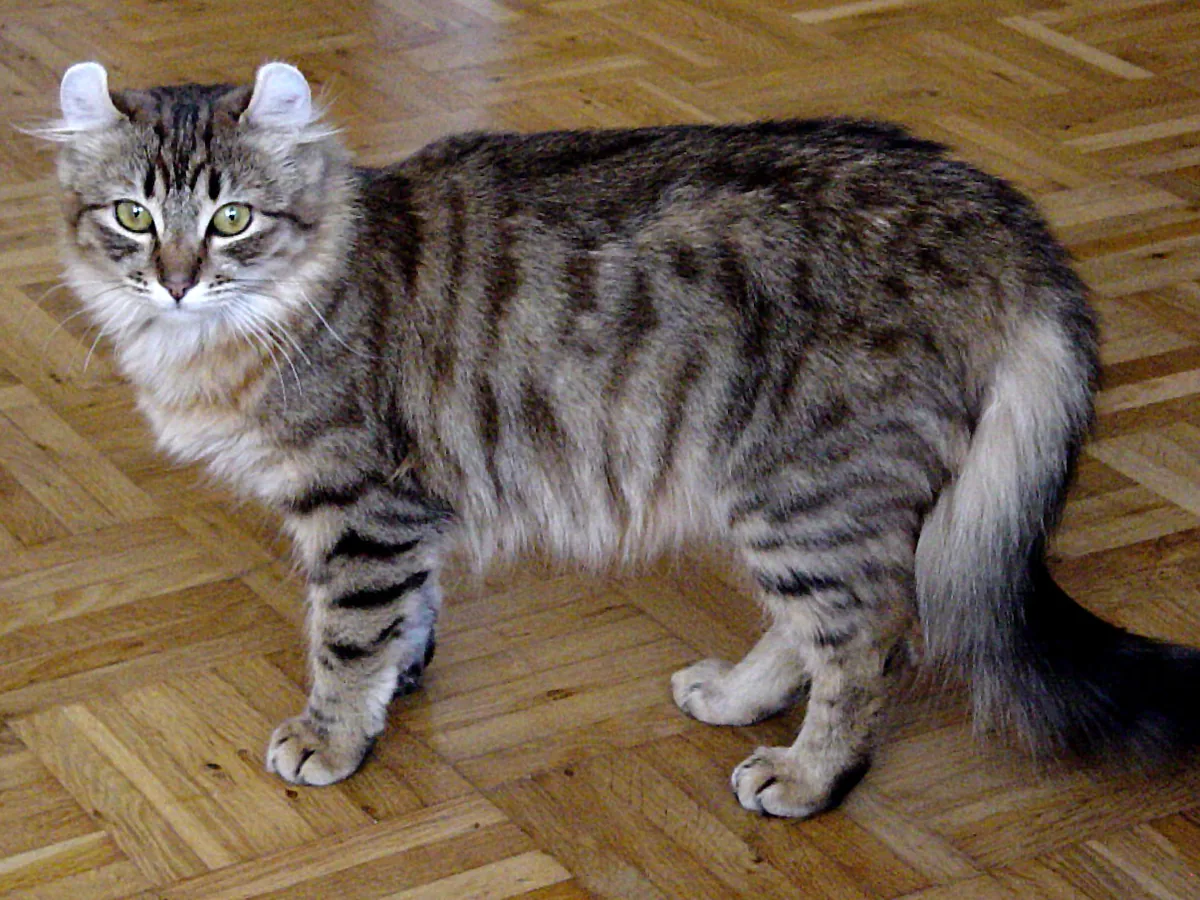
Every American Curl descends from one stray. In June 1981 a black, long-haired, six-month-old female turned up on the doorstep of Joe and Grace Ruga in Lakewood, California. They named her Shulamith. Her first litter produced kittens with the same backward-curling ears, which told the Rugas this was inherited rather than an injury, and test matings established that a single dominant gene, Cu, was responsible. A breed programme followed, an American Curl was first shown in 1986, TICA granted championship status to the long-haired variety in 1992, and in 1999 the CFA admitted the American Curl as the first breed allowed into its championship class with both long-haired and short-haired divisions at once.
Kittens are born with straight ears. Curling begins within about forty-eight hours and is finished by four months; after that the ear does not change. A show cat's ear curls back in an arc of 90 to 180 degrees, and a cat whose ear tips touch the back of the skull is disqualified. The base of the ear should feel firm and the tip flexible. Both coat lengths are soft, flat and silky; the body is medium, 2.3-4.5 kg, with a modified wedge head and a plumed tail. All colours are accepted.
Personality is the reason people stay with the breed after the novelty of the ears wears off: friendly, adaptable, interested in visitors, and notably good with other animals. The ears need one rule, not a routine: never bend them, and have a vet check the ear canal at every visit.
Care essentials
- Grooming
- Shorthairs need a weekly rub with a rubber brush; longhairs need a comb twice a week plus daily during shedding, with attention to the ruff and the tail. The ears are the part that matters: wipe the visible outer ear with a soft cloth, never push a cotton bud into the canal, and check for wax, redness or a bad smell every week because the curl can make the opening harder to see.
- Exercise & play
- Moderate. One or two play sessions a day of ten minutes, plus climbing furniture and a window seat. This is not a cat that needs scheduled athletics, but it does get bored, and boredom shows up as night vocalising and pawing at doors.
- Feeding
- Easy to overfeed because it is sociable and asks at the table. A 3.5-4 kg adult needs about 190-220 kcal a day in two meals. Keep the cat lean: the breed is small-boned relative to its appetite, and extra weight is hard on joints. Wet food and fresh water encourage intake.
- Home setup
- Indoor, with secure screens. Provide a warm high spot and a quiet place to retreat when the house is busy. Because the ears are the breed's weak point, avoid households where cats are handled roughly by young children, and do not let the cat push its head through tight gaps or wear tight collars that rub the ear base.
Health
- Ear haematoma and infection, usually from rough handling, scratching or ear mites; the curled shape makes daily inspection harder, not the ear itself more fragile.
- Hypertrophic cardiomyopathy has been reported in the breed at low frequency; pre-breeding echocardiograms are recommended but no breed DNA test exists.
- Obesity, common in indoor cats of this size and easy to miss under a long coat.
- No breed-specific cartilage or bone disease: the curl gene affects the ear cartilage only, unlike the Scottish Fold mutation.
The most important thing to know is what the breed does not have. The American Curl's dominant Cu gene alters ear cartilage and nothing else; it is not the same mutation as the Scottish Fold gene, and there is no associated osteochondrodysplasia, the painful joint disease that affects Fold cats. A kitten sold as a curl-eared cat with stiff legs or a thick tail should be examined for something else entirely. Ear cleaning is the one maintenance task that cannot be skipped.
Health information here is general and not a substitute for veterinary advice. If your cat shows symptoms, contact a vet.
Frequently asked
Do American Curl ears stay curled for life?
Yes, once set. The curl begins within about two days of birth and is fixed by four months; it does not loosen with age. What changes is the amount of curl, which varies from cat to cat, and pet-quality cats may have ears that are only slightly curled.
Are curled ears a health problem?
No. The Cu gene affects ear cartilage and nothing else, and there is no link to the joint disease seen in Scottish Folds. The practical issue is inspection: a curled ear is harder to look into, so owners should check weekly and have a vet look at the canal during check-ups.
Can I breed two American Curls together?
No. The gene is dominant, so a curl-to-curl mating is unnecessary and produces heavily affected kittens with cartilage problems. Responsible breeders pair a curl with a straight-eared cat, which yields roughly half curled and half straight-eared kittens, the latter being essential to the programme.
Why are American Curls so expensive in China?
Supply. The breed is uncommon worldwide and very rare in China, with few local breeders and most kittens imported, which adds quarantine, transport and paperwork to the price. Expect CNY 8,000-20,000. Ask for the import documents and the parents' echocardiogram reports before paying.