Abyssinian
阿比西尼亚猫 · Foreign shorthair · Ethiopia (claimed); developed in Britain
The Abyssinian's origin story is mostly fiction.
Quick facts
- Weight
- 3-5 kg, females smaller
- Length
- Body 30-40 cm; long tapering tail
- Lifespan
- 12-15 years
- Typical price
- US$800-2,000
Temperament & lifestyle
About the breed
The Abyssinian's origin story is mostly fiction. Nineteenth-century cat fanciers claimed the breed came straight from Abyssinia, present-day Ethiopia, and named it accordingly; the founding cat shown in Britain in the 1870s was said to have been brought back by a soldier. Modern genetics points elsewhere: the Indian Ocean coast and Southeast Asia, along trade routes that carried the ticked-coat gene. Whatever the route, the breed was fixed in Britain by the 1920s and is now among the most popular shorthairs.
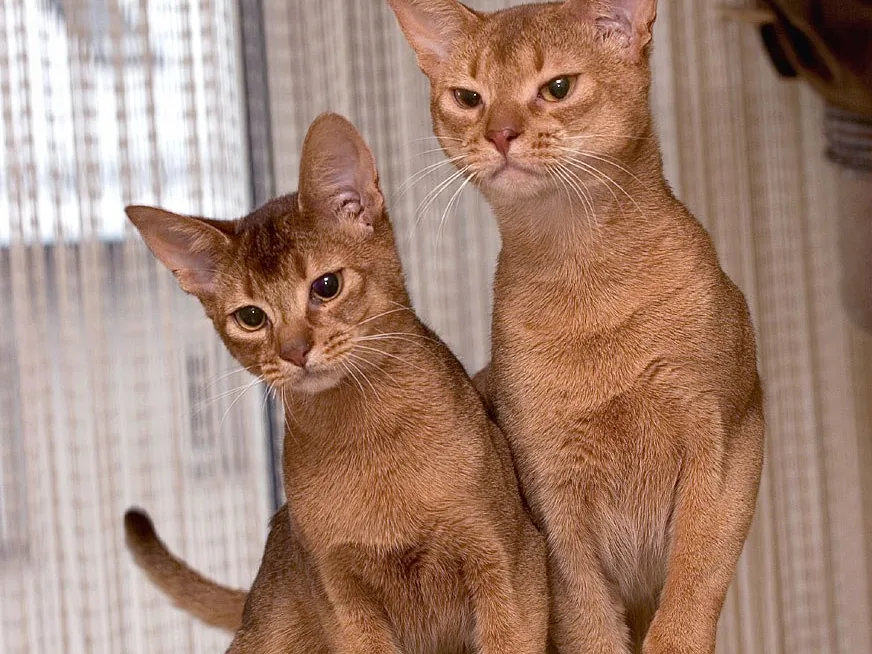
What defines it visually is the ticked coat. Each hair is banded with several colours and tipped dark; there are no stripes or spots except faint barring on the inner front legs. The effect is a warm, shimmering pelt. The body is lithe and muscular on fine bone, with long legs, a wedge head, large alert ears and green or gold eyes outlined in dark. Weight is only 3-5 kg; long legs and tail make it look bigger.
Living with one is closer to living with a small monkey than a cat. Abyssinians are on the go from waking to sleeping, climb everything, open cupboards and need a job. They are not lap cats and will not be happy left alone with nothing to do; a bored Aby invents occupations, usually involving your shelves. The upside is a cat that engages with people constantly, learns tricks, and stays playful well into old age. This is not a breed for someone who wants a decorative cat.
Care essentials
- Grooming
- The easiest coat in this set. A weekly rubdown with a rubber curry or damp chamois removes loose hair and spreads skin oils; brushing is barely needed and a bath every two or three months is plenty. Check ears weekly - large ears collect wax - and clean teeth several times a week, because this breed is prone to gingivitis.
- Exercise & play
- High-intensity, short bursts. Twenty minutes of wand chasing twice a day plus a puzzle feeder and vertical climbing space is the minimum. A cat wheel or a harness walk helps. Rotate toys weekly; novelty matters more than quantity. An Aby with a window perch and a bird feeder outside will self-entertain for hours.
- Feeding
- High-protein, moderate-fat food, measured and split into two or three meals. This breed stays lean naturally and should show a visible waist; do not let it free-feed just because it looks thin. Wet food daily supports the kidneys, which matters given the breed's amyloidosis risk. Avoid sudden diet changes - Abyssinians have sensitive guts.
- Home setup
- Any size home works provided there is height and mental work. Cat-proof cupboards, secure window screens, and remove breakables from high shelves. Because it is sociable, a second young cat or a cat-friendly dog reduces boredom damage. Keep a routine: this cat dislikes being shut out of rooms and will protest loudly at closed doors.
Health
- Progressive retinal atrophy (rdAc) - DNA test available, affects vision from early adulthood
- Pyruvate kinase (PK) deficiency - inherited anaemia, DNA test available
- Renal amyloidosis - familial kidney disease, the breed's most serious concern
- Periodontal disease and gingivitis - very common, needs home brushing
- Patellar luxation - occasional, usually mild
Ask for rdAc and PK deficiency DNA results on both parents; both are simple recessive and entirely avoidable with testing. Renal amyloidosis has no definitive test, so a pedigree with no early kidney deaths matters more than any certificate. Annual bloodwork including kidney values from age three is worth the cost.
Health information here is general and not a substitute for veterinary advice. If your cat shows symptoms, contact a vet.
Frequently asked
Why does my Abyssinian have a ticked coat?
The ticked pattern comes from a dominant gene that makes each hair shaft band with alternating light and dark pigment instead of forming stripes. Abyssinians carry it in its most extreme form, so the coat looks uniform from a distance and finely textured up close. It is the same gene behind ticked tabbies in other breeds.
Are Abyssinians good with children?
With school-age children, usually yes - they are playful, sturdy enough for gentle handling and enjoy being part of the action. Toddlers are harder: the cat will not tolerate rough grabbing and will simply leave. Teach children to let the cat come to them and never to corner it, and the pairing works well.
Does an Abyssinian need a companion cat?
It benefits enormously from one. Abyssinians are social and high-energy, and a second young cat absorbs the chasing and wrestling that humans cannot provide for hours. If you cannot add a cat, plan on substantial daily play and puzzle work - a solo Aby with a bored owner becomes a chewer and a shelf-clearing machine.
Abyssinian vs Somali - is the Somali just a longhaired Abyssinian?
Genetically, yes: the Somali is the longhaired expression of the same breed, produced by a recessive longhair gene that occasionally appears in Abyssinian litters. In practice they are shown and registered as separate breeds. The Somali needs more grooming; temperament is essentially identical.