Nebelung
内华达猫(雾猫) · Semi-longhair (Russian Blue type) · United States (Denver, Colorado), 1980s
The Nebelung is a young breed with an old-fashioned look.
Quick facts
- Weight
- 7–11 lb (3.2–5 kg); males to 15 lb
- Length
- 16–20 in (41–51 cm) nose to tail base
- Lifespan
- 15–18 years
- Typical price
- $700–$1,500
Temperament & lifestyle
About the breed
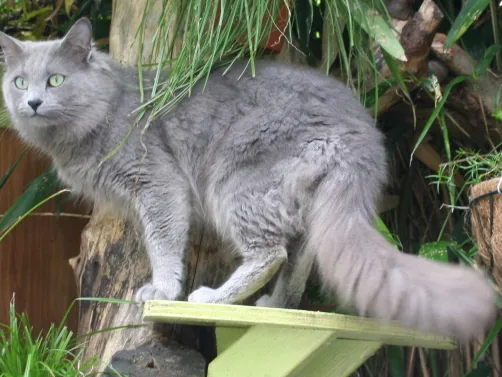
The Nebelung is a young breed with an old-fashioned look. In the early 1980s Cora Cobb, in Denver, kept a black domestic shorthair and a cat she believed was a Russian Blue. One kitten in a litter, a long-haired blue male she named Siegfried, fitted neither parent. Cobb bred him back and built a line around him, naming the breed Nebelung — German for "creature of the mist" — after the fog-grey coat. The CFA accepted the breed for registration in 1987 and for championship in 1997. It remains rare: litters are few and waiting lists are normal.
The Nebelung is essentially a semi-longhaired Russian Blue. The coat is a clear, even blue-grey with silver tipping, longer at the ruff, the hind-leg britches and the tail, where it forms a plume. It is fine, soft and slower to mat than a Persian's, but still needs real grooming. The body is long, lithe and elegant; the head a modified wedge with large pointed ears and vivid green eyes. Adults weigh seven to eleven pounds, males up to fifteen.
Temperament is reserved but not cold. A Nebelung hides when guests arrive, then reappears once the house settles. With its own people it is affectionate, playful into middle age and quietly funny — it likes high shelves, games of fetch and supervising housework. It does not do well with chaos, and it usually picks one person as its favourite while staying polite to everyone else. The voice is soft and seldom used, which makes the rare complaint easy to miss.
Care essentials
- Grooming
- Twice a week with a steel comb, more in spring. The silky semi-long coat mats less than a Persian's but tangles behind the ears and in the britches if ignored. No clipping, no frequent baths — a bath every two to three months is plenty and preserves the silver sheen.
- Exercise & play
- Moderate. Fifteen to twenty minutes of chase-and-fetch daily, plus a tall cat tree. Nebelungs like to run, jump and survey from height; a floor-level home with no vertical space bores them.
- Feeding
- Measured meals twice a day; the breed tends toward obesity in middle age, especially males. 1/2 cup of dry food daily for an average adult, or the wet equivalent. Long-lived cats benefit from wet food and regular dental care rather than high-protein marketing.
- Home setup
- Indoor only. Give it a quiet room to retreat to and warn guests not to chase it — forced socializing sets the relationship back weeks. It tolerates other cats and calm dogs, and does poorly with constant noise or rearranged furniture.
Health
- Hypertrophic cardiomyopathy — occasional; no widespread breed screening protocol yet
- Small gene pool — ask about COI, lineage and outcrossing
- Dental tartar and gingivitis in older cats
- Obesity in indoor, middle-aged adults
- Matting and skin problems under the coat if grooming lapses
There is no long list of breed-specific diseases, which is unusual for a modern breed, but the population is tiny and derived from a handful of founders. Ask breeders for cardiac ultrasounds on the parents and be suspicious of anyone producing many litters of a rare breed. A well-kept Nebelung commonly reaches 16 to 18 years; plan for the cost of a long-lived cat.
Health information here is general and not a substitute for veterinary advice. If your cat shows symptoms, contact a vet.
Frequently asked
Is a Nebelung the same as a Russian Blue?
No. It is a separate breed with the same blue-grey color and green eyes but a semi-long coat, a longer body and a plumed tail. The Nebelung was developed in the US in the 1980s from cats of uncertain Russian Blue descent.
Do Nebelung cats shed a lot?
Moderately. The coat is semi-long and silky with a soft undercoat, so there is a noticeable spring shed and some hair year-round. Twice-weekly combing keeps it off the furniture; it is far less work than a Persian.
Are Nebelungs good with strangers?
Not immediately. They typically disappear when the doorbell rings and come out after guests leave. Forcing interaction backfires; let the cat approach on its own terms and it will settle within a few visits.
How much does a Nebelung cat cost?
About $700–$1,500 in the US, when you can find one. The breed is rare, litters are small, and many breeders keep waiting lists. A low price from an unknown seller usually means no health testing or a mislabelled long-haired mixed breed.
Care and health guides
Similar breeds
All breeds →
%22/><g fill=%22none%22 stroke=%22%23B98A5E%22 stroke-width=%226%22 stroke-linecap=%22round%22 stroke-linejoin=%22round%22 opacity=%220.55%22><path d=%22M150 150c0-28 22-50 50-50s50 22 50 50%22/><path d=%22M150 140l-14-34 34 14%22/><path d=%22M250 140l14-34-34 14%22/><circle cx=%22182%22 cy=%22146%22 r=%224%22 fill=%22%23B98A5E%22/><circle cx=%22218%22 cy=%22146%22 r=%224%22 fill=%22%23B98A5E%22/><path d=%22M200 162c6 6 12 6 18 0%22/></g><text x=%22200%22 y=%22230%22 text-anchor=%22middle%22 font-family=%22system-ui,sans-serif%22 font-size=%2230%22 font-weight=%22700%22 fill=%22%23A9764B%22 opacity=%220.75%22>YC</text></svg>)