Burmilla
伯米拉猫 · Shorthair · Burmese × Chinchilla Persian (United Kingdom) · United Kingdom
The Burmilla exists because of an accident in 1981.
Quick facts
- Weight
- 8–12 lb (3.6–5.4 kg)
- Length
- Body 16–19 in (40–48 cm), tail 10–12 in (25–30 cm)
- Lifespan
- 15–18 years
- Typical price
- $800–$2,000; in China ¥6,000–15,000
Temperament & lifestyle
About the breed
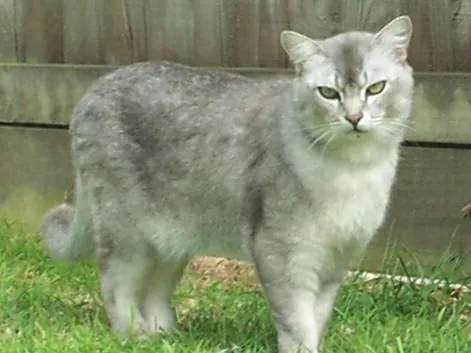
The Burmilla exists because of an accident in 1981. A lilac European Burmese female and a chinchilla Persian male, both kept at the London cattery of Baroness Miranda von Kirchberg, mated just before the Persian was due to be neutered. The kittens were silver with black tipping at the very ends of the hairs and green eyes rimmed in black — a look nobody had planned. The name joins Burmese and chinchilla, and a golden variety followed.
The coat is the defining feature: short, close-lying and soft, with tipping confined to roughly the top third of each hair, so the cat reads as a pale silver veil rather than a tabby. Burmillas are born with faint tabby markings that fade as the adult coat grows in. Body type is foreign but moderate — a gently rounded wedge, long legs, 8–12 lb.
Temperament splits the difference between its parents: the Burmese's curiosity and mischief, the Persian's calm. They play hard for twenty minutes, sleep for three hours, follow you into the bathroom, and greet strangers without hiding. They are notably quiet for a Burmese relative and get on with dogs and children.
Care essentials
- Grooming
- Brush twice a week with a soft slicker; the tipped coat is fine and sheds little, but loose hairs dull the silver. No bathing unless it gets into something greasy.
- Exercise & play
- Moderate: one or two 15-minute sessions plus a tall perch. It likes climbing and puzzle feeders, and will use a cat wheel if introduced young.
- Feeding
- Measured meals, 1/2 to 2/3 cup dry or 5 oz wet daily; the breed is calm enough to gain weight, and PKD-affected cats need a renal diet once diagnosed.
- Home setup
- Adaptable to flats and families. It wants a sunny window, a perch at head height and someone around in the evening; it tolerates dogs and children well.
Health
- Polycystic kidney disease (PKD) — inherited from the Chinchilla Persian side; DNA test available
- Progressive retinal atrophy (PRA) — Burmese-lineage risk, DNA test available
- Hypertrophic cardiomyopathy (HCM) — echocardiogram breeding cats
- Periodontal disease — Burmese relatives are prone to gingivitis from about three years
Two very different ancestors mean two different risk sets, so ask for PKD and PRA DNA results on both parents plus a recent heart scan. The gene pool is small; breeders outcross to Burmese and Persian lines, and a kitten's pedigree should show that.
Health information here is general and not a substitute for veterinary advice. If your cat shows symptoms, contact a vet.
Frequently asked
What does "Burmilla" mean?
It is a portmanteau of Burmese and chinchilla, the two parent breeds. The first litter was an accidental mating between a lilac Burmese and a chinchilla Persian in London in 1981.
Do Burmillas shed much?
Less than most shorthairs, but the fine tipped hairs show up on dark fabric. A twice-weekly brush removes most loose coat, and shedding peaks in spring and autumn.
What health tests should a Burmilla breeder do?
PKD and PRA DNA tests on both parents, plus an echocardiogram for HCM. PKD comes from the Persian side and PRA from the Burmese side, so testing only one parent leaves half the risk unchecked.